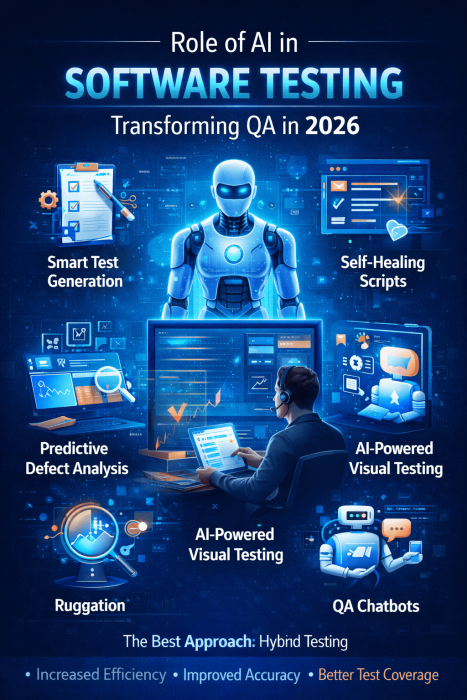
Artificial Intelligence (AI) is rapidly transforming the software industry—and software testing is no exception. In 2026, AI is not replacing testers but enhancing their capabilities, making testing faster, smarter, and more efficient.
📌 Introduction
Traditional software testing often involves repetitive tasks, manual effort, and time-consuming processes. With the integration of AI, testing is becoming more predictive, automated, and intelligent, enabling teams to deliver high-quality applications at speed.
🔹 How AI is Changing Software Testing
1. Smart Test Case Generation
AI can analyze application behavior, requirements, and user flows to automatically generate test cases.
Benefits:
- Reduces manual effort
- Improves test coverage
- Speeds up test design
2. Self-Healing Test Automation
AI-powered tools can automatically update test scripts when UI or code changes occur.
Example:
Tools like Selenium are now being enhanced with AI capabilities to reduce script maintenance.
Benefits:
- Less maintenance effort
- Faster execution
- Improved reliability
3. Predictive Defect Analysis
AI can analyze historical data to predict where defects are most likely to occur.
Advantages:
- Focus testing on high-risk areas
- Reduce critical bugs in production
- Improve overall product quality
4. Visual Testing with AI
AI helps in identifying UI inconsistencies by comparing visual elements.
Use Cases:
- Layout validation
- Cross-browser UI testing
- Detecting pixel-level differences
5. Intelligent Test Execution
AI can prioritize and execute test cases based on:
- Risk level
- Code changes
- Usage patterns
Outcome:
Faster feedback and optimized testing cycles.
6. Chatbots & Virtual Assistants in QA
AI-powered chatbots assist testers by:
- Answering queries
- Generating reports
- Suggesting test scenarios
🔹 Benefits of AI in Software Testing
🚀 Increased Efficiency
AI automates repetitive tasks, saving time and effort.
🎯 Improved Accuracy
Reduces human errors and increases precision.
⚡ Faster Time-to-Market
Accelerates testing cycles and release processes.
📊 Better Test Coverage
Ensures more scenarios are tested effectively.
🔹 Challenges of AI in Testing
Despite its advantages, AI adoption comes with challenges:
- High initial investment
- Need for skilled professionals
- Dependency on quality data
- Learning curve for teams
🔹 Future of AI in Software Testing
The future of AI in testing looks promising with trends like:
- Autonomous testing systems
- AI-driven CI/CD pipelines
- Advanced analytics and reporting
- Increased adoption across industries
Leave a Reply